
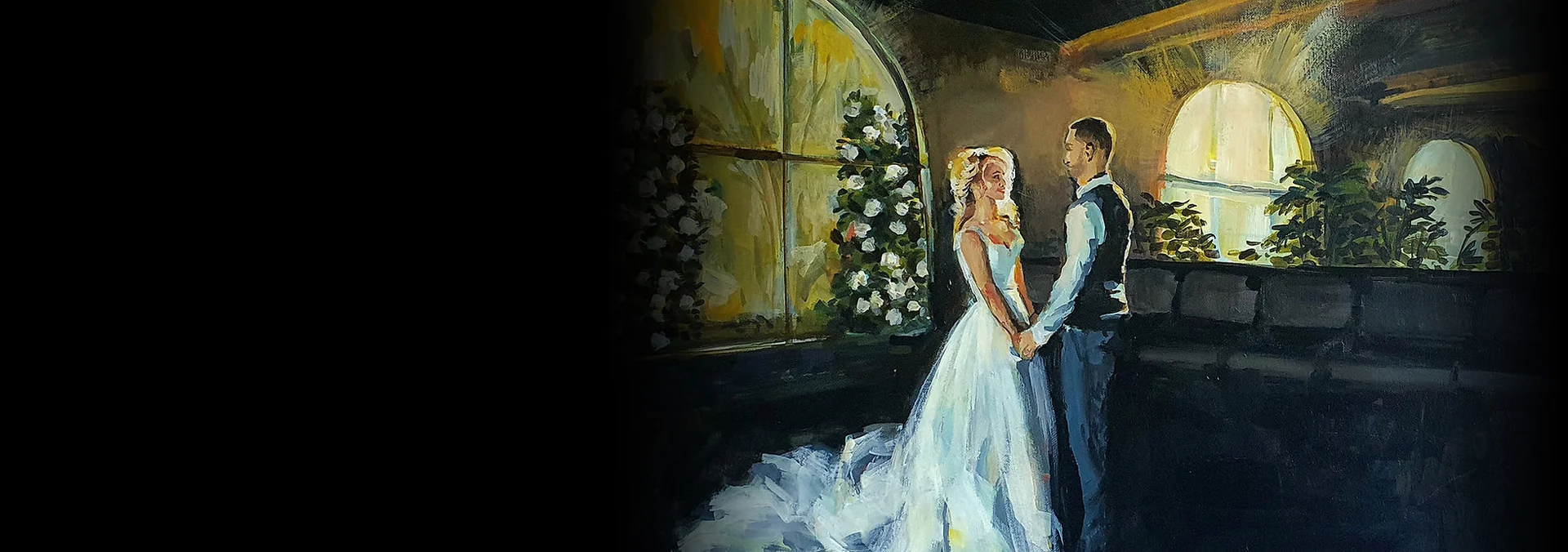
The medium your artist works in shapes more than the look of your wedding painting. It decides how much can be finished on the night, how long you'll wait for delivery, and how the piece should be framed and hung. Here's how the main options compare.
Across our directory, oil and acrylic dominate live couple paintings, with oil slightly ahead. Watercolour is the most common choice for guest portraits, followed by ink, pens and markers, with a handful of artists working in pencil, graphite or charcoal.
The mediums at a glance
| Medium | Look | Drying time | Studio finishing | Framing |
|---|---|---|---|---|
| Oil | Rich, deep colour and soft blends | Slow: days to touch dry, months to cure | Almost always | Varnished, usually no glass |
| Acrylic | Bright and versatile, bold to painterly | Fast: minutes for thin layers | Common, often lighter | Varnished, usually no glass |
| Watercolour | Light, airy and translucent | Fast, slower in humidity | Sometimes, for couple paintings | Behind glass with a mat |
| Charcoal | Monochrome with dramatic contrast | None, but needs fixing | Usually some refinement | Fixed, behind glass with a mat |
| Ink and pencil | Crisp lines, quick and illustrative | Instant to seconds | Rarely | Sleeve on the night, glass to frame |
Oil
Look: oil gives rich, deep colour and soft, seamless blends that flatter skin tones, candlelight and golden-hour glow. It's the classic fine-art look, and many realist, romantic and photorealistic wedding portraits are painted in oil.
Drying time: oil dries by slowly oxidising rather than evaporating. That's a gift while painting, because the artist can keep blending for hours, but it means the canvas is still wet at the end of the night. Thin layers may be touch dry within days; thicker paint takes longer, and a full cure can take months. Some artists use quicker-drying mediums to speed things up.
Studio finishing: expect it. Almost every oil painter in our directory refines the painting in the studio, sharpening faces and details before varnishing, which is why oil paintings usually take longest to deliver.
Durability and framing: oil on quality canvas or linen is extremely durable. Once varnished it's usually framed without glass, often in a simple float frame. Hang it out of direct sun and away from steamy bathrooms and kitchens.
Suits: evening and candlelit receptions, romantic or realistic portraits, and couples happy to wait for a true heirloom.
Acrylic
Look: acrylic is water-based and remarkably versatile. It can look bold and graphic or loose and painterly, and it handles bright, saturated colour beautifully. Colours darken slightly as they dry, which experienced painters allow for.
Drying time: fast. Thin layers dry in minutes, so the artist can build up layers quickly at the event and the painting can travel sooner. On hot, dry or windy Australian days paint can dry on the palette too quickly, so outdoor painters often keep a mister handy.
Studio finishing: common, but often lighter than for oil. Most acrylic painters in our directory who describe their process still add final details and varnish in the studio.
Durability and framing: acrylic stays flexible and resists yellowing. Varnish adds protection from dust and UV light, and like oil it's usually framed without glass.
Suits: bright, modern palettes, daytime and outdoor weddings, large canvases, and couples who'd like the painting sooner.
Watercolour
Look: transparent washes let the white of the paper glow through, giving a soft, airy, romantic feel. It suits loose, impressionistic scenes as well as delicate portraits.
Drying time: quick, although humid days slow it down.
Studio finishing: guest portraits are finished on the spot. Watercolour couple paintings may be tidied up afterwards, and some artists prepare a sketch before the event so the live painting comes together faster.
Durability and framing: paper is more delicate than canvas. Frame watercolour behind glass with a mat (also called a mount) so the glass doesn't touch the paper, ideally with UV-filtering glazing and archival materials. Keep it out of direct sunlight, as some pigments can fade.
Suits: garden ceremonies, daytime weddings, pastel palettes and guest portraits.
Charcoal
Look: monochrome, with deep blacks, soft greys and expressive marks. It feels timeless and a little editorial, a natural match for couples who love black-and-white photography.
Drying time and finishing: there's nothing to dry, but charcoal smudges easily, so it needs a fixative spray. Expect some refinement after the event. At least one Perth artist in our directory works in layered charcoal on archival paper.
Durability and framing: frame behind glass with a mat or spacer so nothing rubs the surface.
Suits: black-tie and formal weddings, minimalist homes, and couples who prefer a monochrome look.
Ink, marker and pencil sketches
Look: crisp, confident lines, often with a wash of watercolour or marker for colour. This is the language of fashion illustration, one of the most popular styles for guest portraits in our directory.
Drying time and finishing: ink and markers dry almost instantly and pencil doesn't need to dry at all, so these sketches are designed to be finished in minutes and handed over on the night.
Durability and framing: pigment inks on acid-free paper last well, but some markers are less lightfast and can fade in sunlight. If a guest frames their portrait, glass and a shady wall are best.
Suits: guest portraits, larger guest lists and fashion-forward weddings.
Style matters as much as medium
Medium and style are separate choices. Two oil paintings can look completely different, one photorealistic and the other loose and expressive, and artists in our directory describe their work as everything from photorealistic and romantic to expressive and fashion-inspired. In Melbourne, for example, Olga of Wedding Day Painter works in a contemporary impressionist style, balancing recognisable faces with loose, fresh brushwork; you'll find her alongside other local painters on our Melbourne page. Whoever you consider, look at complete paintings, not just close-ups.
How to choose
- Want the deepest, most classic finish? Oil, if you're happy to wait.
- Love bright, modern colour? Acrylic.
- Daytime garden wedding with a soft palette? Watercolour.
- Prefer black and white? Charcoal.
- Want favours for your guests? Watercolour, ink or pencil portraits. See live painting vs guest portraits.
- Hanging it on a bright wall? Varnished oil or acrylic copes better than unprotected paper.
Once you have a shortlist, use our questions to ask your wedding painter to check finishing and delivery times, and read what a live wedding painter costs in Australia before comparing quotes. Then browse artists in Melbourne, Sydney, Brisbane, Perth, the Gold Coast, Adelaide, Hobart and Canberra.
Frequently asked questions
Which medium is most common for live wedding paintings?
Among live painters in our directory who state a medium, oil and acrylic are by far the most common, with oil slightly ahead. Watercolour and charcoal are less common for couple paintings, but watercolour is the favourite for guest portraits.
Why do oil wedding paintings take longer to deliver?
Oil paint dries slowly, so the painting is still wet at the end of the night. The artist usually refines it in the studio and waits until the surface is dry enough to varnish before delivering it.
Can a wedding painting be finished on the night?
Guest sketches in ink, pencil or watercolour are finished on the spot. Most live couple paintings in our directory are refined in the studio afterwards, so ask your artist what will be complete when the event ends.
Do watercolour paintings need to be framed behind glass?
Yes. Watercolour on paper should be framed behind glass or acrylic glazing with a mat, ideally UV-filtering and archival, and hung out of direct sunlight.
Is acrylic as durable as oil?
Both are very durable when made with quality materials and varnished. Acrylic stays flexible and resists yellowing, while oil has centuries of track record. Keep either out of direct sun and humidity.
What mediums do guest illustrators use?
In our directory, most guest illustrators work in watercolour or ink, often with fine pens or markers. Some use pencil or graphite, and at least one offers digital illustration.